KidsOnlineLessons Team · November 9, 2026
How to Teach Second Graders to Use a Simple Map Key
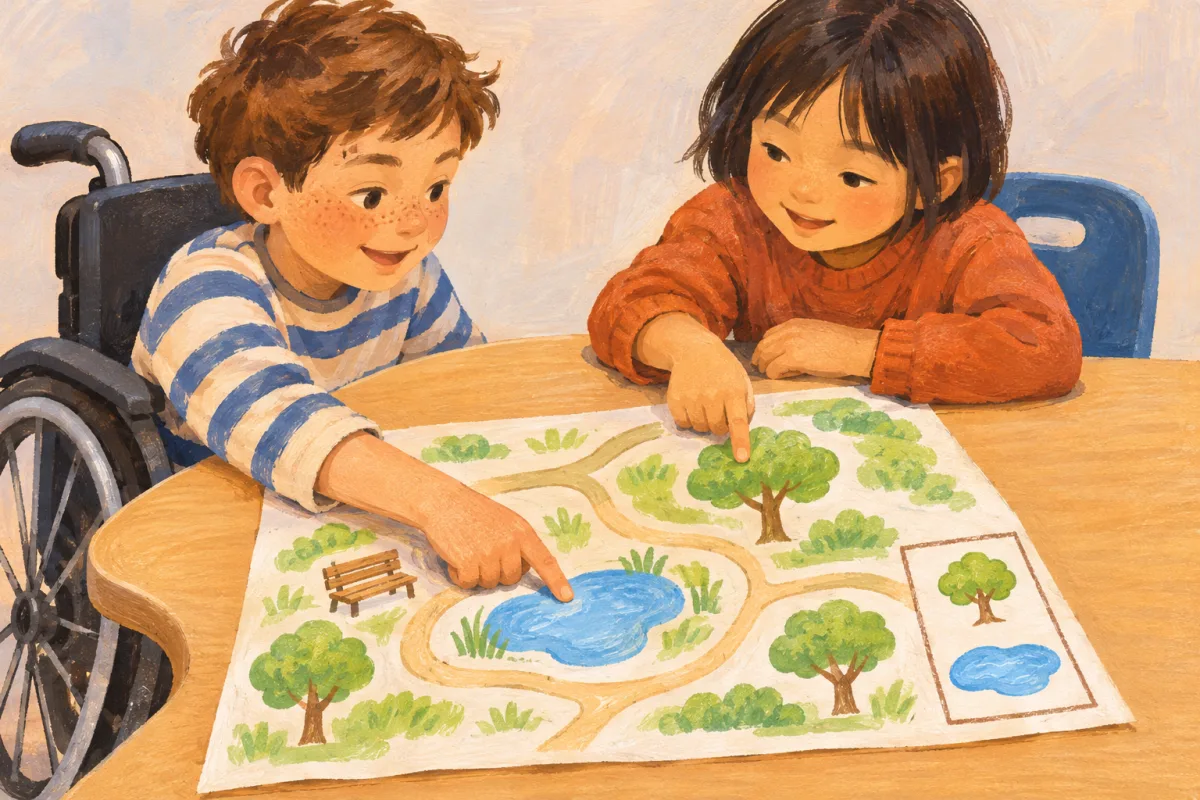
A tree drawn on a park map may stand for one tree, a group of trees, or a picnic area. A reader needs a way to tell which one the mapmaker means. A map key pairs each symbol with its meaning. A second grader can practice by reading a small park map and then making a key for a classmate or family member. Keep the first map simple enough that the reader can check each symbol quickly.
Match a symbol on the map to its meaning
On a sheet of paper, draw a path with a pond on one side and a group of trees on the other. Use a blue oval for the pond and one green tree symbol for the wooded area. Put those same symbols in a box in the corner. Next to the blue oval, write “pond.” Next to the tree, write “wooded area.”
Point to the blue oval on the map. Ask your child to find the same mark in the key and read its label. Then try the tree. Ask what the symbol stands for in this park. If they answer “one tree,” have them read the key and describe what they might expect to see there. One small drawing can stand for a bigger area.
Ask your child to choose symbols a reader can tell apart
Add a picnic shelter to the map. Let your child draw a simple symbol for it and add the same mark to the key. If they choose an oval close to the pond symbol, ask how a reader would tell them apart if both were printed in black and white. They might use a square roof or add a stripe. Let them choose a feature that stays easy to see when the symbols are small.
Have your child make a second shelter symbol elsewhere on the map. Read the key together and ask whether both marks stand for the same kind of place. If they want one to mean something else, invite them to change its design and update the key. A traveler should be able to learn one meaning for each symbol.
Test the park map with a new reader
- Cover the labels on the main map. Ask a reader to find the pond by using the key and matching the blue oval.
- Give a short route. Ask the reader to follow the path from the picnic shelter to the wooded area and name a symbol they pass.
- Ask where they paused. If two marks looked alike, let your child revise one and test it again.
After revising a symbol, check every matching mark on the map as well as the key. Consistency lets a reader apply the same meaning in each location. Save an older version only as a comparison, so the final map and its key do not contradict each other.
When the new reader can explain how they found a place, ask your child which part of the key helped them. For more activities that connect symbols, directions, and spatial reasoning, sign up for a guided second grade learning path with KidsOnlineLessons.