KidsOnlineLessons Team · November 9, 2026
How to Teach Preschoolers to Recognize Circles and Ovals
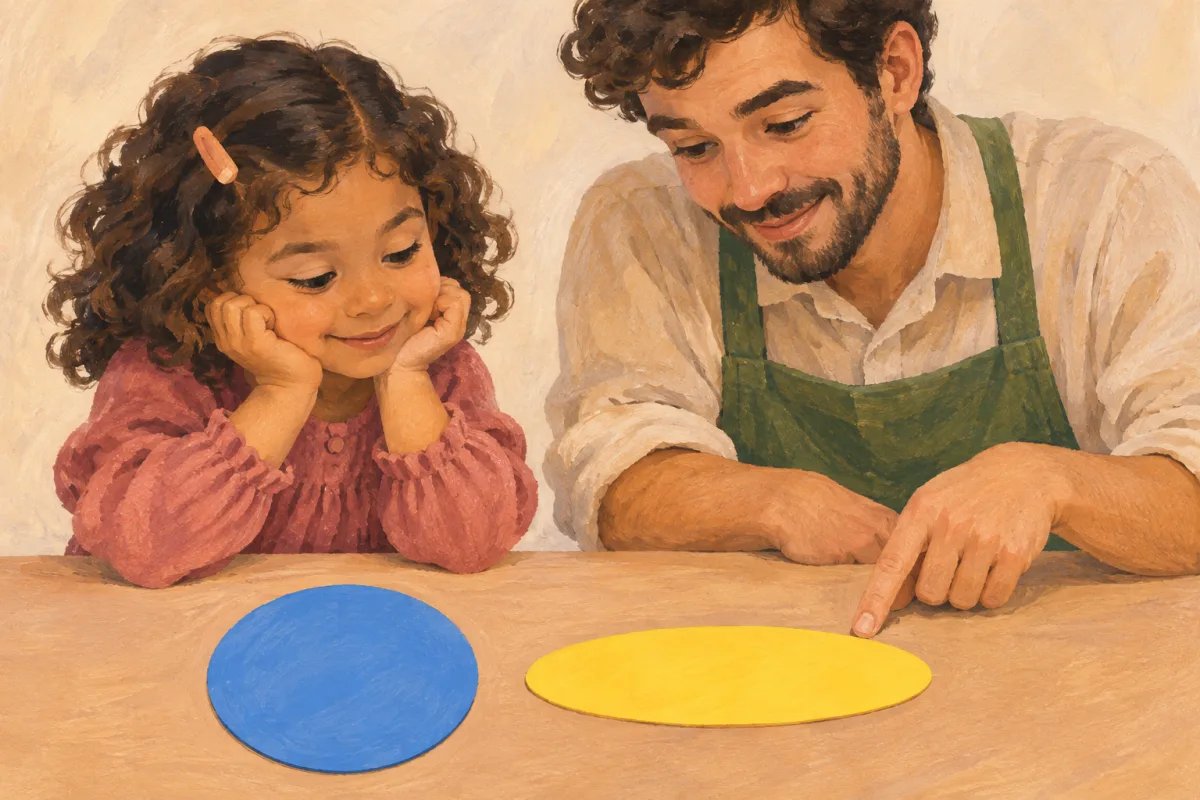
A preschooler may call a paper oval a circle because both shapes have smooth edges and no corners. That’s a good observation. You can build on it by looking closely at a clear example of each shape. Use a round plate and a paper oval with a visibly longer direction. Give your child time to trace, turn, and compare them before asking them to name the shapes on their own.
Trace the edge of a circle and an oval
Lay the plate and the oval cutout flat. Run your finger around the rim of the plate, then around the edge of the paper. Ask your child what feels similar. They might say both go around or that their finger never has to stop at a corner. You can put words to the observation: “Both edges curve all the way around.”
Now look at the space inside each outline. The circle is the same distance across whichever way you measure through the middle. The oval you chose stretches farther in one direction. With a preschooler, you can say, “This oval is longer this way,” and move two fingers apart from the middle toward its ends. Have your child show you the long direction.
Turn the shapes and check what stays the same
Rotate the oval so its long direction points up instead of sideways. Ask your child to find the long direction again. Then turn the plate and ask what changed. A round plate still looks round no matter how you turn it flat on the table. The oval’s long direction can point a different way, but the paper keeps its shape.
If your child uses color to tell the two apart, cut a circle and an oval from the same sheet of paper. Then find a larger and a smaller example of each. Your child can sort them by shape and check each choice by tracing or turning it. If an oval is only slightly stretched, save it until the obvious examples feel familiar.
Look for circles and ovals during a shape hunt
- Start at the table. Compare a round lid with an oval-shaped tray. Look straight down so you can see each outline clearly.
- Trace a shape. Help your child trace around a round lid, then find a paper oval to lay next to the tracing.
- Ask for a clue. Hold up one shape and ask your child to describe it without using its name. See if you can guess what they are holding.
Try a new pair cut from the same color of paper after the first comparison feels familiar. This reduces the chance that color alone supplies the answer. Ask your child to show the curved boundary and the oval’s longer direction, using the actual examples as evidence.
A preschooler who can point to an oval’s long direction even after you turn it is using a feature that stays with the shape. For more games that connect geometry with familiar objects, sign up for a guided preschool learning path with KidsOnlineLessons.