KidsOnlineLessons Team · November 14, 2026
How to Teach Preschoolers More and Fewer With Toy Animals
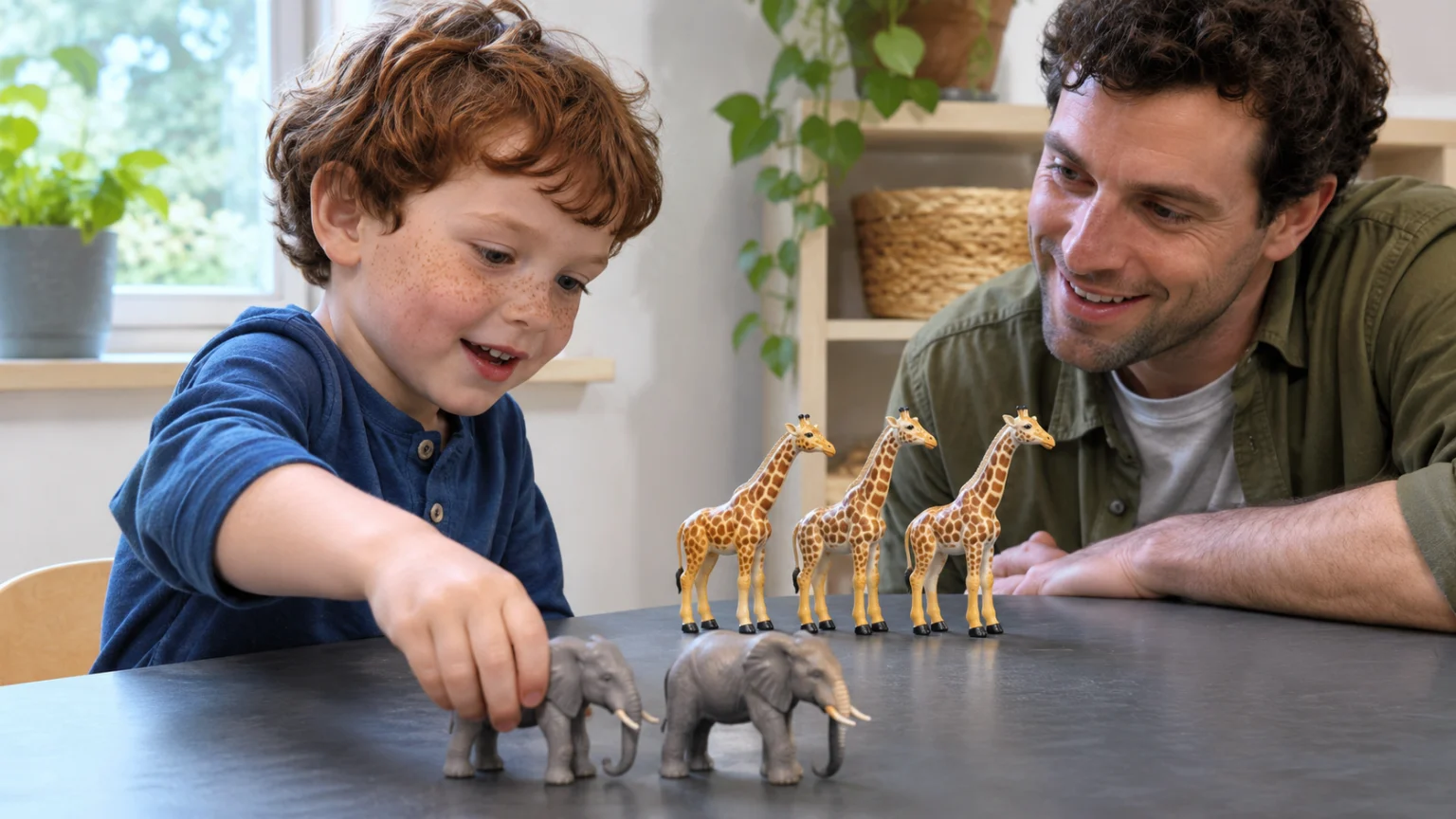
A long line of toys can look like “more” even when another, shorter line contains the same number. Preschoolers often notice space before quantity. Comparing small groups of toy animals helps your child explore what more and fewer actually describe.
Start with a few large, age-appropriate animals. Make one group of two and another of three. You can count if your child enjoys counting, but matching objects one to one offers another way to see the difference without depending on number words alone.
Pair the animals to make quantity visible
Set out two toy cows and three toy sheep. Place each cow opposite a sheep, leaving the extra sheep at the end. Say, “Each cow has a sheep partner. This sheep has no partner, so there are more sheep.”
Then describe the same relationship from the other side: “There are fewer cows.” Using both statements helps your child connect the comparison words. More and fewer refer to the groups relative to each other.
Invite your child to make the pairs. If they gather all the animals together, join the play briefly and then model just one pair. You can rebuild the comparison without treating their exploration as an error.
Change the arrangement without changing the number
Move the two cows farther apart so their line looks longer than the sheep line. Ask, “Did we add any cows?” Pair the groups again to check. The number stayed the same even though the space changed.
Use only a few animals at first so each group remains easy to inspect. Keep the tone curious. Your child does not need to understand this immediately. Repeating the comparison with visible partners gives them evidence they can inspect for themselves.
Try a short sequence:
- Make two small groups and predict which has more.
- Match animals into pairs to check.
- Spread one group out and compare again.
- Add or remove one animal and describe what changed.
When the groups are equal, introduce “the same number” or “equal.” Show that every animal has a partner and none is left over.
Use comparison words in a pretend-play problem
Pretend the animals need beds made from large fabric squares. Put out three animals and two beds. Ask whether there are enough beds for each animal to have one. Your child can solve the problem by matching rather than answering only with words.
If they suggest sharing a bed, acknowledge the thoughtful solution. Then clarify the comparison: “They could share. If each needs a separate bed, we need one more.” Math talk can remain flexible while the quantities stay accurate.
Finish by letting your child arrange equal groups for a toy picnic or rest time. Notice whether they use matching to explain their choice. That reasoning matters more than a quick guess. For more practical early math activities, visit KidsOnlineLessons and sign up for a guided preschool learning path.