
KidsOnlineLessons Team · November 9, 2026
How to Make Ten With a Kindergarten Ten Frame
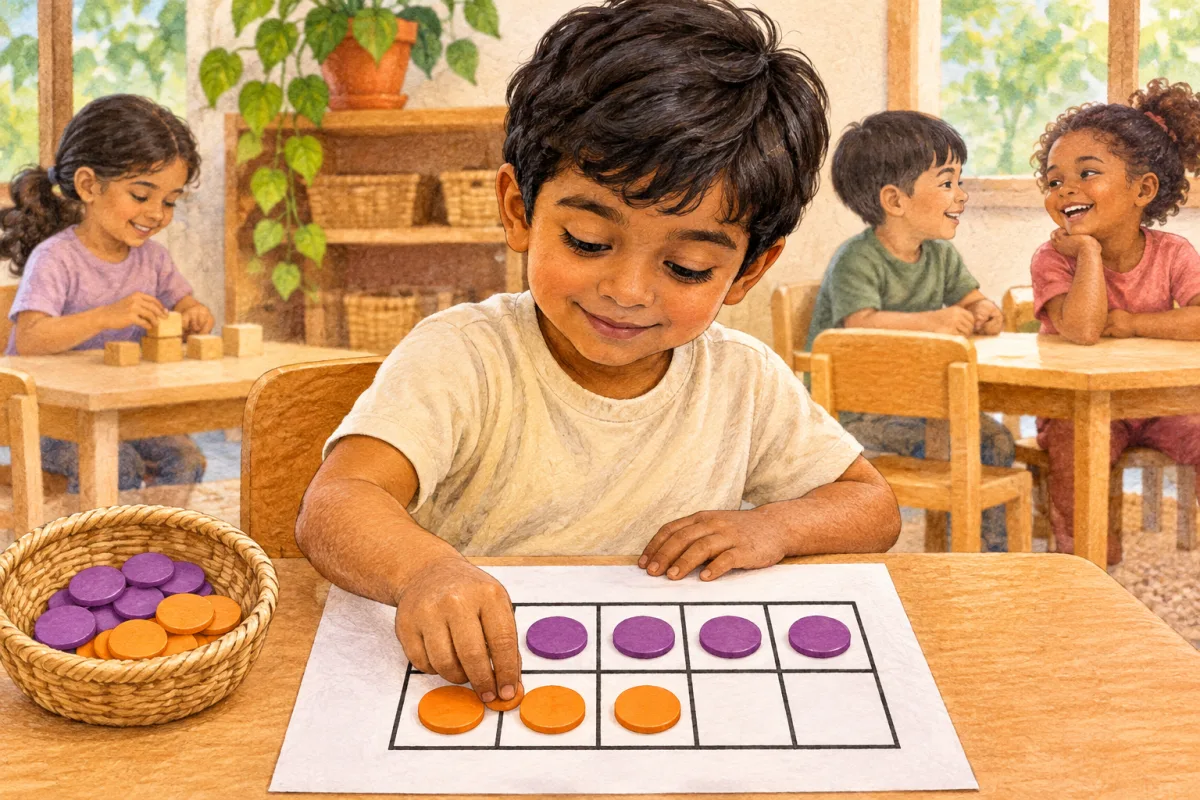
A child may count eight counters correctly and still have to start from one when you ask how many more would make ten. A ten frame gives that question a visible shape. The frame has ten spaces in two rows of five. When some spaces are filled, the empty ones show how many more are needed. You can make a frame on a piece of paper and practice with two colors of counters.
Fill the ten frame in a consistent order
Draw two rows of five boxes. Set out counters that fit easily inside the boxes. Ask your child to place five purple counters across the top, starting on the left. Then ask them to place three purple counters in the second row, again starting on the left. You can ask, “How many are here already?” Give your child a chance to count all eight or see five on top and three below.
Point to the empty boxes and ask, “How many more would fill the frame?” Offer orange counters. Have your child fill each of the empty boxes with one orange counter. The two colors show where they started and what they added. Say the number pair together: “Eight and two make ten.”
Ask your kindergartner what they noticed
If your child counts every box before answering, let them. Then invite them to look for a faster way to count next time. “What do we know about the top row when it’s full?” That question points them to five as a group they can keep in mind. They can count on from five when they need to check how many boxes are filled.
Clear the frame and try a starting group of four. Your child might see one open space at the end of the first row and five open spaces underneath. Ask them to show you how they know six more are needed. A child might count the open spaces, fill them and count the new counters, or say “one and five.” Each approach gives you a chance to see how they are thinking.
Use the frame to record different ways to make ten
- Start with six. Fill the top row and one box below. Ask how many more finish the second row.
- Keep a record. After building a pair, write it as an equation such as
6 + 4 = 10. Have your child point to the counters each number describes. - Switch the colors. Build four in the first color and six in the second. Compare the total with the earlier example.
Try two or three number pairs at a time. When your child can describe both the filled and empty spaces, let them make a new challenge for you. For more ways to explore number pairs and early addition, sign up for a guided kindergarten learning path with KidsOnlineLessons.