KidsOnlineLessons Team · November 11, 2026
How to Help Toddlers Follow One-Step Directions During Play
“Put your shoes away, find your coat, and come here” asks a toddler to hold several instructions in mind. If you want to practice following directions, shrink the request to one visible action. Play offers many chances to pair a short phrase with something your child can do immediately.
Choose a relaxed moment with a familiar toy. Your aim is to help your toddler connect words with actions, rather than to test obedience. A child who is tired, absorbed in another activity, or unfamiliar with a word may need a different approach.
Start with an action your toddler already enjoys
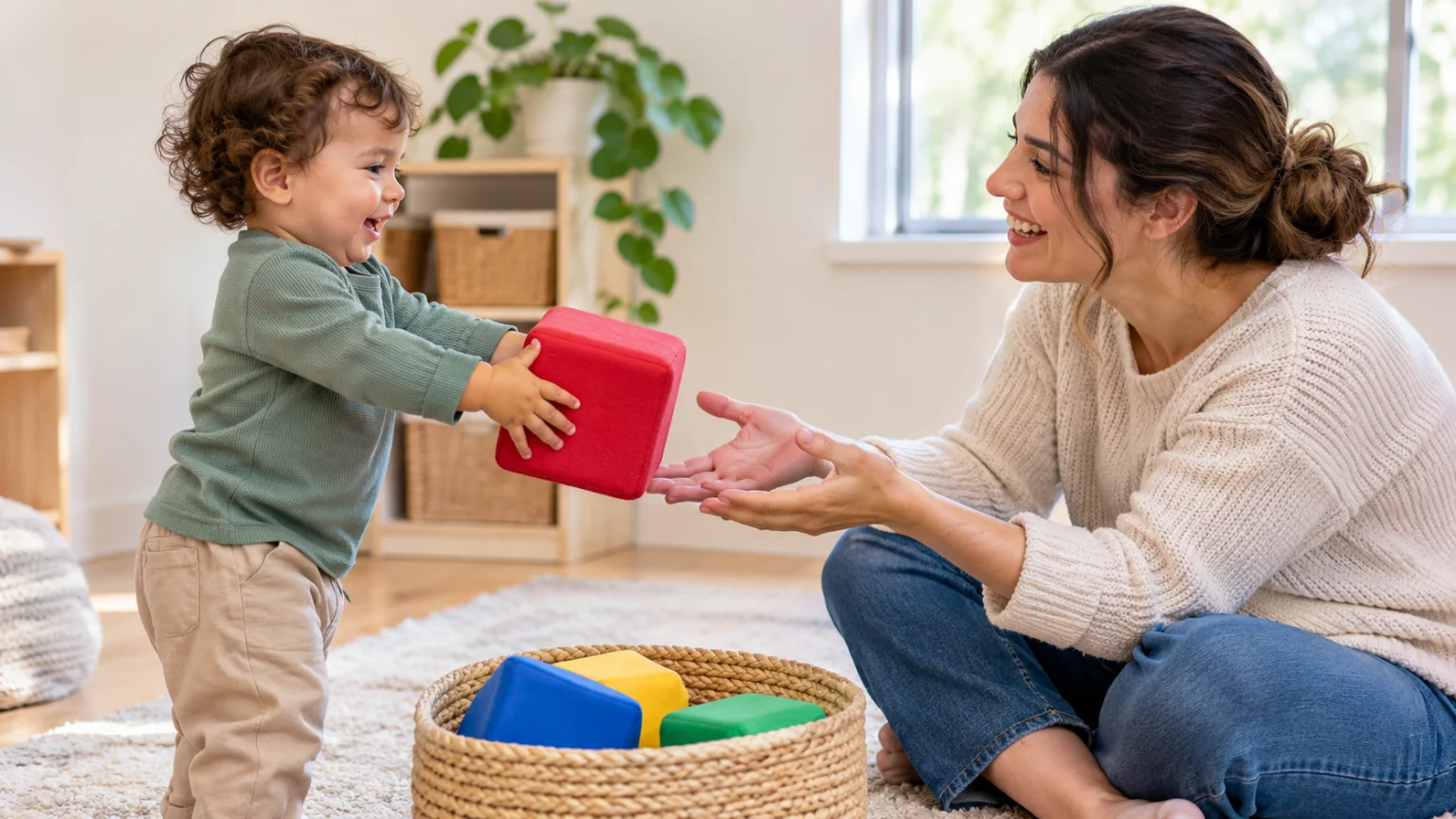
Sit together with a large soft block and a shallow basket. Show the block and say, “Give me the block,” holding out your hand. Keep your words short, then allow several quiet seconds for a response.
If your child hands it over, describe the action: “You gave me the block.” Return it so the exchange stays playful. If they look uncertain, model the request with another large toy, or gently demonstrate by placing your own block in your open hand.
Avoid repeating the instruction faster and louder. More language can make the original request harder to pick out. A calm gesture and a clear model often provide more useful information.
Change one part of the direction at a time
Once “give me” feels familiar, try “Put the block in.” Point to the basket so the destination is clear. Keep the same block and basket while introducing the new action. Changing the object, verb, and location together adds unnecessary demands.
Let your child choose when to take another turn. You might place the basket nearby and wait for them to pick up the block again. Then offer one simple instruction that fits what they are already doing.
A short play session could include:
- “Give me the block,” with an open hand.
- “Put it in,” with a point toward the basket.
- “Take it out,” after you model the movement.
- “Bring the bear,” when the bear is close and visible.
Use familiar words in your home language. Understanding directions can be supported through any language your family uses comfortably.
Notice the support that helps your child respond
Watch whether your toddler follows the action after hearing the words, seeing your gesture, or watching a model. Each response helps you choose what to do next. Over time, you can try a familiar request with a smaller gesture and see what happens.
A refusal does not automatically mean a child failed to understand. They may want to keep the toy or continue their own plan. Offer a choice or join their play rather than making every interaction a practice round.
Carry one clear direction into cleanup, such as “Put the bear in.” Thank your child for helping care for shared spaces. For more gentle language activities built around everyday play, visit KidsOnlineLessons and sign up for a guided toddler learning path.