
KidsOnlineLessons Team · November 18, 2026
How to Compare Numbers to Ten in Kindergarten
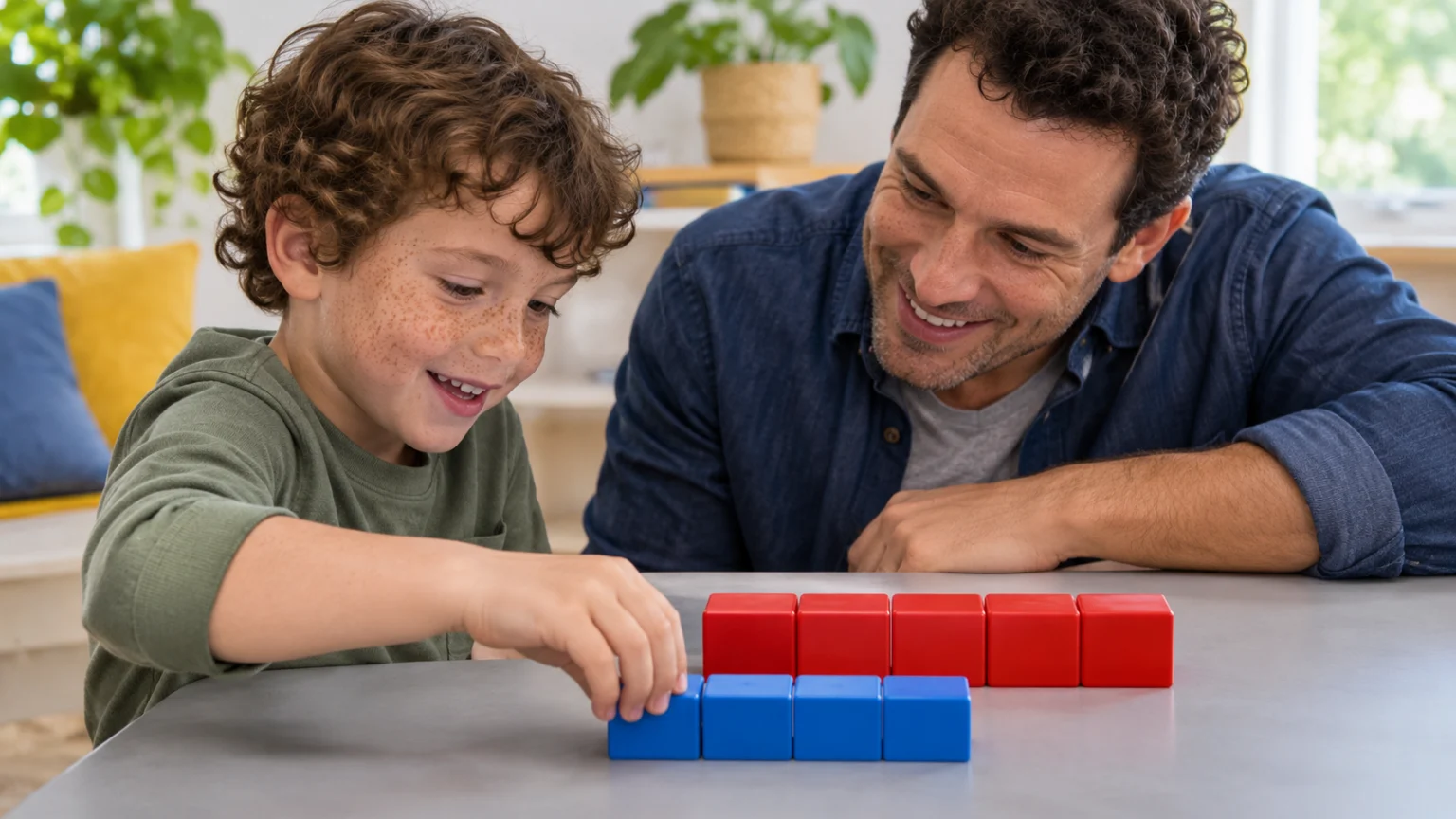
Your kindergartener may count two groups correctly yet still choose the more spread-out group as the larger amount. Comparing numbers becomes clearer when children can match objects, count accurately, and explain what the totals mean. Begin with quantities they can handle comfortably, then connect those groups with written numerals.
Gather ten large objects of one kind and ten of another, such as two colors of blocks. Start with small groups before using the full collection. Keep the objects similar in size so visual differences do not overwhelm the quantity comparison.
Compare groups by matching objects one to one
Set out four red blocks and six blue blocks. Ask which group your child thinks has more, then pair one red block with one blue block. Two blue blocks remain without partners.
Explain, “There are more blue blocks because some are left after every red block has a partner.” Then describe the reverse relationship: “There are fewer red blocks.” Count each group to connect the visible comparison with four and six.
If your child changes their first answer after matching, welcome the revision. Checking a prediction against evidence is useful mathematical thinking. The goal is a reasoned comparison, rather than defending the first guess.
Connect the groups with numerals and equal amounts
Write 4 beneath the red group and 6 beneath the blue group. Ask which numeral names the larger quantity. Point back to the objects whenever your child needs support.
Next make two groups of five. Pair the objects and notice that none are left over. Explain that the groups have the same number, or equal amounts. Move one group farther apart and check again; rearranging objects does not change how many are present.
Try these short comparisons:
- Compare three objects with five.
- Compare seven with seven.
- Compare nine with eight.
- Compare a group with zero objects to a nonempty group.
Keep the numeral cards beside the matching groups while you talk. Ask your child to explain using matching, counting, or a clear drawing. Different correct strategies can reveal the same quantity relationship.
Introduce comparison language before formal symbols
Use sentences such as “Six is greater than four” and “Four is less than six.” Connect them with the more and fewer language your child already understands. There is no need to rush into memorizing comparison signs before the relationship is meaningful.
If you do introduce symbols, explain what they state and read the complete comparison aloud. Keep objects nearby so the notation remains connected to quantities, rather than becoming a direction-guessing exercise.
Finish with your child building two groups for you to compare. Explain your reasoning and let them check it. You can intentionally pause to ask whether your matching is accurate, inviting them to become a thoughtful partner. For more guided number-sense activities using objects, pictures, and mathematical language, visit KidsOnlineLessons and sign up for a kindergarten learning path.