KidsOnlineLessons Team · November 19, 2026
First Grade Nonfiction Questions Using Text Features
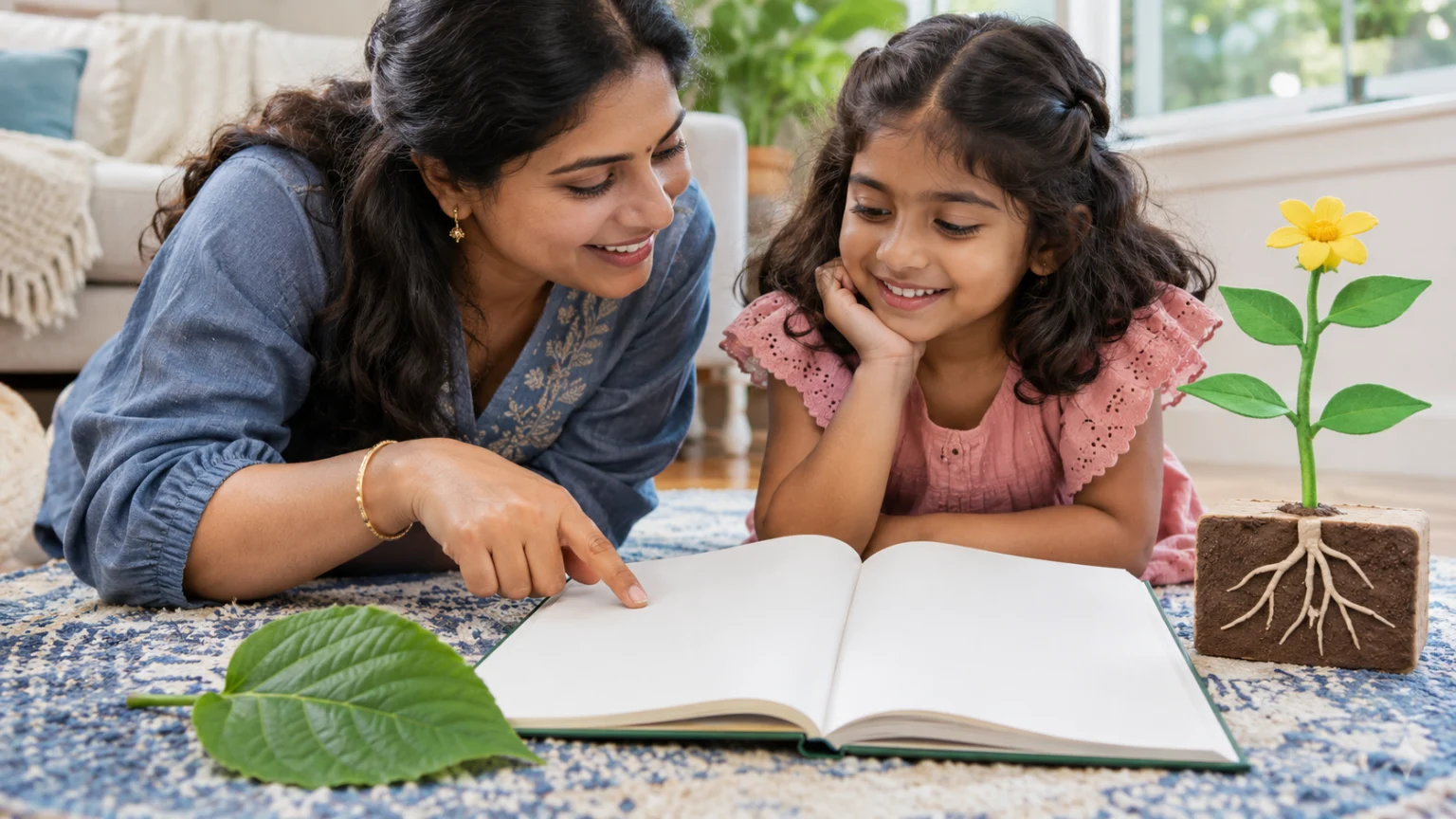
Your first grader may open a nonfiction book and head straight for the photographs. Those pictures can be a valuable entry point, especially when you connect them with headings, captions, labels, and diagrams. Text features help readers predict what a section covers and locate information for a question.
Choose a short, age-appropriate nonfiction book on a topic your child enjoys. You can read difficult sentences aloud while they study the features. Understanding how information is organized does not need to wait until every word can be decoded independently.
Preview a heading and ask a useful question
Before reading a section, look at its heading together. If it says “Plant Roots,” ask what your child expects to learn. Help turn the prediction into a question, such as “What do roots do?”
Read the section and return to the question. Ask which sentence or picture helps answer it. Explain that a heading gives a clue about the subject of a section, but the details still need to be read and checked.
If the heading is playful or vague, discuss that too. A title such as “Down Below” may require the nearby picture and first sentence to clarify the topic. Text features guide readers without always giving a complete answer by themselves.
Compare what pictures and captions contribute
Choose one photograph and describe only what is visible. Then read the caption. Ask what new information it adds. A picture might show roots in soil, while the caption explains that they take in water.
Look at a labeled diagram next. Show how a line or arrow connects a label with a particular part. Read the label, trace the connection, and locate the part on the diagram.
Try a few focused questions:
- “Which feature helps us find this section?”
- “What does the caption explain?”
- “Where does the label’s line point?”
- “Which feature helped answer our question?”
Avoid treating every visible detail as a fact stated by the author. A child can notice a brown background without knowing what kind of soil it represents.
Use a feature to find information independently
Ask a small question that the book can answer, such as “Which part holds the plant in place?” Invite your child to choose a heading, caption, or diagram to inspect first. Read supporting text together as needed.
If the first feature does not answer the question, model looking elsewhere. Information seeking often involves checking more than one place. The useful habit is choosing a next step and verifying the answer.
Keep the question visible on a note so your child can return to it while exploring the page.
Finish by having your child show another person one feature and explain how it helped. This values clear communication as well as finding facts. For more guided nonfiction reading activities that connect curiosity with careful evidence, visit KidsOnlineLessons and sign up for a first grade learning path.