KidsOnlineLessons Team · November 17, 2026
A Preschool Sink-or-Float Investigation With Large Objects
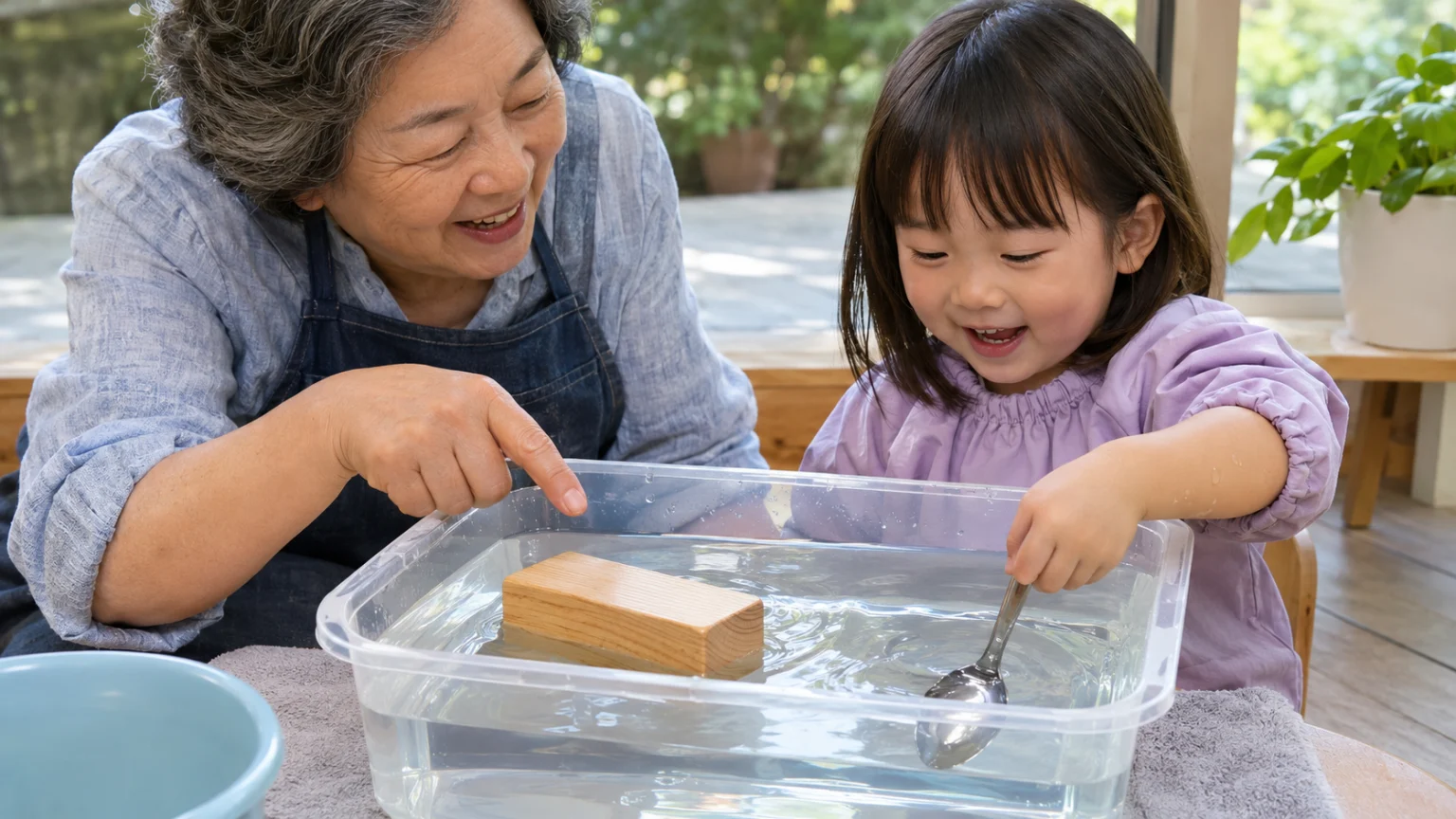
Your preschooler might predict that every heavy object sinks or every small object floats. A sink-or-float investigation gives them a chance to test those ideas with visible evidence. You do not need a complicated explanation of buoyancy to begin; careful observation and a willingness to revise a prediction are valuable goals.
Use a shallow tray with a small amount of water and stay within arm’s reach throughout. Choose large, washable objects without loose parts, sharp edges, batteries, or absorbent stuffing. Empty the tray as soon as the activity ends.
Predict and test one object at a time
Begin with a solid wooden block and a solid metal spoon. Hold up the first object and ask, “What do you think will happen when we place this in the water?” Accept a point or a spoken prediction.
Lower the object gently rather than throwing it in. Watch together and describe the result: “It stays at the surface,” or “It rests on the bottom.” Introduce float and sink as words for those observations.
Make it clear that a prediction is an idea to test, not an answer your child needs to get right. You can model changing your mind: “I expected this to sink, but it floated. Let’s look carefully at what happened.”
Compare objects without oversimplifying the result
Test the spoon next and place it beside the block afterward. Ask what was different about the results. Your child may notice the material, shape, or weight. Record their observation in ordinary language without turning one example into a universal rule.
A large object can float and a smaller object can sink. Shape and material both matter, so avoid teaching “heavy sinks, light floats” as the explanation. For preschool practice, it is enough to say that different objects behave differently in water.
Keep a simple record:
- Draw each object before testing it.
- Place its drawing under a surface or bottom sketch.
- Test the object again to check the result.
- Discuss any observation that surprised you.
If an object partly submerges while remaining at the surface, describe exactly what you see. Real observations do not always fit a child’s first picture of floating as staying completely dry.
Finish with a question for another investigation
Ask which object your child would like to test next time and why. Choose a safe suggestion together, but save it if attention is fading. A useful investigation can end with curiosity rather than an exhaustive collection of results.
You might compare the same object across two trials before introducing a new one. Repeating a test helps your child notice consistency.
Dry the objects and wipe up splashes together. Caring for the materials and water area belongs to the learning experience too. Keep any record so your child can recall what they actually observed. For more guided early science activities that encourage thoughtful questions, visit KidsOnlineLessons and sign up for a preschool learning path.